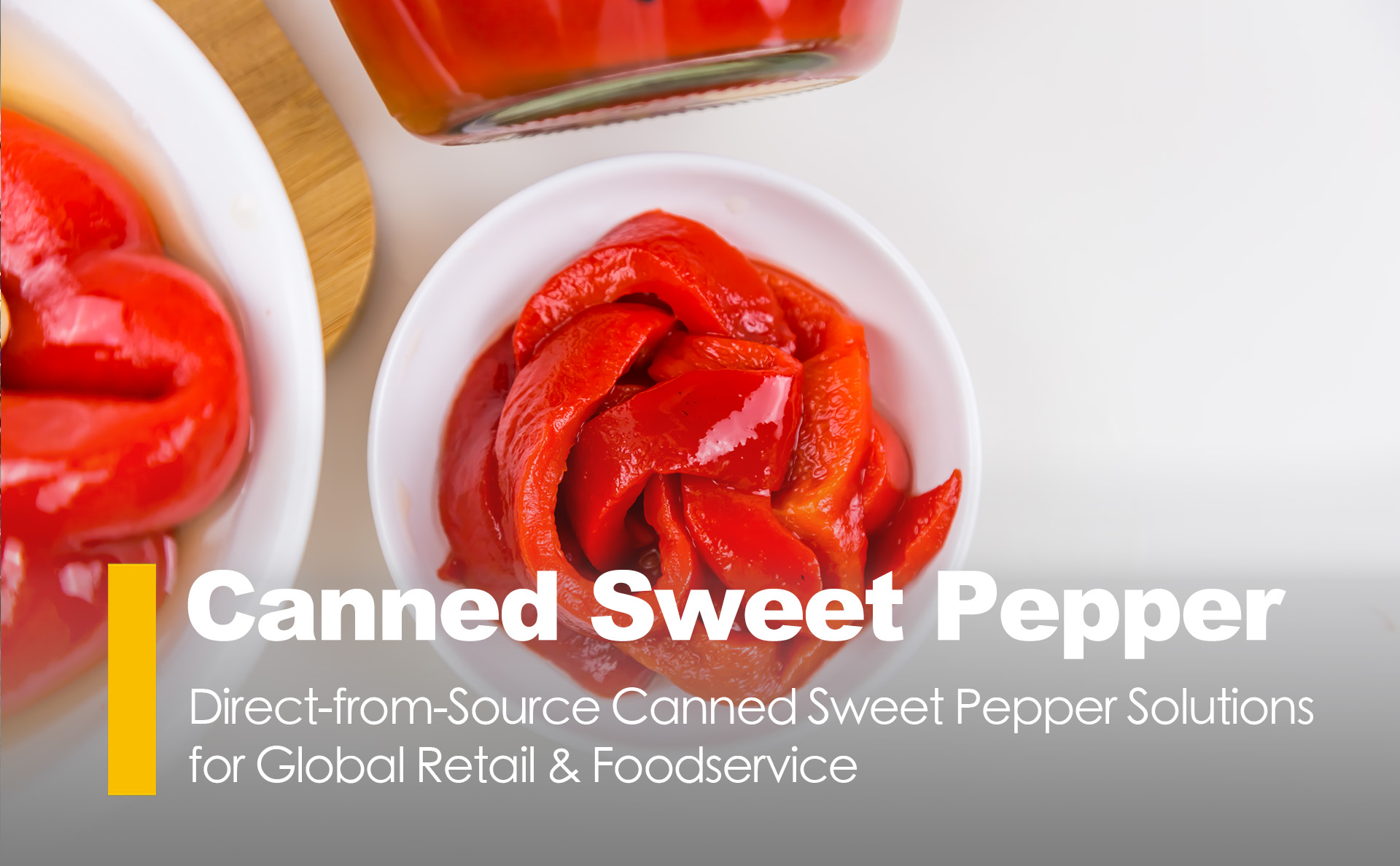


Four questions decide this purchase: What does retail need — and what does foodservice need? Whole, strips or dices? Tin or glass jar? And how do you judge a supplier when every quote looks different? Choosing canned roasted sweet peppers is not choosing a vegetable. It is choosing a cut, a pack format, an application and a supply chain — and getting any one of them wrong costs more than the peppers.
What Are Canned Roasted Sweet Peppers?
Sweet peppers, fire-roasted, peeled and packed in oil, brine or water, then retorted. Roasting is what separates them from plain canned sweet peppers: it adds a smoky flavour, softens the flesh and removes the skin, so the product is ready to use straight from the tin or jar.
Peeled peppers are smooth and ready for pizza, sandwiches and salads. Skin-on roasted peppers are firmer and more rustic, and suit dishes where texture matters more than appearance.
Whole
Strips
Dices (Pieces)
Puree is a form some processors offer. It is not part of Countree's canned pepper line.
Choosing the Right Roasted Sweet Pepper Varieties
Red roasted sweet peppers. The standard line. Colour holds after roasting, sweetness is strongest, and the same product works for retail shelves and foodservice kitchens.
Yellow and other colours. Mixed colours give a retail pack or a finished dish visual contrast. Red is the stocked line; if you need yellow, green or mixed colours, confirm availability and MOQ with the factory before you spec them into a listing.
Whole vs. strips vs. pieces. Decide by end use, not by habit:
Retail display — Whole (appearance sells the pack)
Pizza, sandwiches, salads — Strips (ready to use, no prep)
Sauces, ready meals, ingredients — Dices (even distribution, controlled portion)
Secondary processing — Whole (you control the cut)
Compare the five things that actually differ: appearance, prep convenience, size consistency, end use and pack-to-cost match. A cut that saves prep in a kitchen can waste yield in a factory.
Canned vs. Jarred Roasted Sweet Peppers: Which Packaging Works Better?
This is the decision most buyers get wrong, because the two formats look interchangeable on a quote and are not.
Canned roasted sweet peppers. Opaque tins, from 80 g retail tins up to 2,950 g (3,000 ml) commercial tins. Tins cover the widest range of industrial and commercial specs. In transport, watch for denting and corrosion; in spec, check the can lining.
Jarred roasted sweet peppers. Glass jars, 314–1,000 ml. The buyer sees the product, which is why jars win on retail shelves. The trade-off is breakage risk in transport, and the closure and seal become the spec to check.
Metal Tins
Product display: Opaque
Size range: 80 g–2,950 g tins
Transport: Denting, corrosion
Best for: Wholesale, foodservice, food processing
Spec focus: Tin size, capacity, lining
Glass Jars
Product display: Product visible
Size range: 314–1,000 ml jars
Transport: Breakage
Best for: Retail, branded products
Spec focus: Jar size, closure, seal
The Container Math — What Quotes Never Show
Drained weight per 20'FCL from Countree's live spec tables:
Tin 185 g (125 g drained): 3,600 cartons → 10,800 kg drained
Tin 390 g (250 g drained): 1,650 cartons → 9,900 kg drained
Tin 790 g (500 g drained): 1,700 cartons → 10,200 kg drained
Tin 2,500 g (1,500 g drained): 1,175 cartons → 10,575 kg drained
Tin 2,950 g (1,800 g drained): 1,000 cartons → 10,800 kg drained
Tin 80 g retail (60 g drained): 2,000 cartons → 8,640 kg drained
Jar 580 ml (330 g drained): 1,800 cartons → 7,128 kg drained
Jar 1,000 ml (560 g drained): 2,518 cartons → 16,921 kg drained [TO CONFIRM]
Tins from 185 g up deliver 9,900–10,800 kg of drained peppers per container — a spread of about 9%. Format barely changes container efficiency. Two exceptions: the 80 g retail tin is the low outlier at 8,640 kg, and the 580 ml jar runs about 28% below comparable tins at 7,128 kg. No format wins outright. The right choice depends on your channel, your market, your positioning and your volume.
Canned Roasted Sweet Peppers for Different Market Applications
Retail Markets and Private Label
Shelf display, label design and pack size decide the listing. Retail packs run 12–28 oz in glass jars and tins; artwork takes about two weeks. More than 70% of Countree's pepper exports are private label.
Foodservice and Commercial Kitchens
A10 / 104 oz tins and EVOH bulk packs cut repeat prep. Strips go straight onto pizza and sandwiches; whole peppers suit salads and cold platters.
Food Manufacturers and Industrial Applications
Diced and custom cuts, calibrated by Brix, pH and cut tolerance, and checked by X-ray. The line serves pizza, pasta sauce, ready meals and antipasti.
Pizza & Flatbreads
Pack: A10 / 104 oz tin, EVOH
Salads
Pack: Retail jar, A10 tin
Sauces & Pasta
Pack: A10 / 104 oz tin
Sandwiches
Pack: Retail jar, foodservice tin
What Should Buyers Check Before Ordering Bulk Roasted Sweet Peppers?
Product specifications. Confirm variety and colour, cut (whole, strips or dices), net weight, drained weight, ingredient declaration, filling medium, texture and appearance. The number that matters most is drained weight, not net weight: a 790 g tin holds 500 g of peppers (63.3% drain rate); a 2,950 g tin holds 1,800 g (61.0%). Two tins the same size can hold different amounts of usable product — compare suppliers on drained weight per container, not on tin size.
Processing and quality control. Raw-material sorting, roasting and peeling, size consistency, retort and seal control, microbiological and physico-chemical testing. Countree runs 100% X-ray foreign-body detection and accepts SGS/Intertek pre-shipment inspection.
Shelf life, storage and transportation. Shelf life is 36 months. Keep packaging intact and store per the label. For container shipments, confirm the remaining shelf life at shipment before you order.
Certifications and food safety documentation. BRC A+, IFS Higher Level, SQF, HACCP, ISO 22000, FDA/FSVP, Kosher, Halal, with BSCI and SMETA/Sedex audits. Ask for the certificate scope and validity for your market — a badge on a page is not the same as a valid certificate for your shipment.
Private Label and OEM Options for Roasted Sweet Peppers
Custom packaging and specs: tin or jar, whole/strips/dices, filling medium (oil, brine, water), and sizes from 80 g retail tins to 2,950 g commercial tins and 314–1,000 ml jars. Labelling covers brand design, market language, nutrition and ingredients, and retail-ready requirements.
Send an OEM inquiry with these eight items — a supplier can quote from this alone:
Product type — Red / yellow / mixed peppers
Cut style — Whole / strips / dices
Packaging — Tin / glass jar
Net weight — Target net weight
Drained weight — Target drained weight
Annual volume — Estimated yearly volume
Destination market — Target export market
Private label — Yes / no
How to Evaluate a Bulk Roasted Sweet Pepper Supplier
Five checks:
Manufacturing capacity — stable production and bulk delivery, not one good shipment.
Raw material sourcing — a stable supply channel. Countree grows on 50,000 mu of planting bases with 100+ cooperatives and runs 5 factories.
Quality management — a working food-safety system, not a badge list: the certifications above, plus 100% X-ray detection.
Packaging flexibility — tins, jars and EVOH across retail, foodservice and industrial sizes.
Export experience — familiarity with your market's import and labelling rules. Countree supplies 100+ countries and holds FDA/FSVP registration, with a US office (Countree USA LLC, Mason, Ohio).
Frequently Asked Questions About Canned Roasted Sweet Peppers
Are canned roasted sweet peppers ready to eat?
Yes — commercially retorted and ready to use. Check the label for the filling medium and any preparation note.
What is the difference between roasted red peppers and sweet peppers?
Roasted describes the process; red describes the colour and variety. Red roasted is the standard line.
Are roasted sweet peppers available in bulk packaging?
Yes — A10 / 104 oz tins and EVOH bulk packs for foodservice, with a standard MOQ of 1 × 20'FCL (about 1,000–2,200 cartons, multi-SKU mixed loads). Trial orders of 300–500 cartons per SKU are possible.
What is the difference between canned and jarred roasted peppers?
Tins suit wholesale, foodservice and processing; jars suit retail display. See the comparison above — the choice follows your channel, not the product.
Can roasted sweet peppers be customized for private label brands?
Yes. Private label is the core business — over 70% of exports. Artwork takes about two weeks.
What should importers check when buying canned roasted sweet peppers?
Spec, ingredients, drained weight, certifications and supplier capacity — in that order.
Ready to source premium canned roasted sweet peppers?
Looking for a reliable canned roasted sweet pepper supplier? Whether you need retail-ready packaging, foodservice formats or customised private label, the right partner starts with matching specifications to your market.
Contact our team to discuss your product specifications, packaging preferences and bulk sourcing needs: sales@countreefood.net
View Our Complete Product RangePartner with a Proven Global Supplier
Countree Food combines global quality certifications, category expertise, a trusted brand, and a comprehensive product offering for roasted sweet peppers. As demand for premium vegetable products grows, partnering with an experienced supplier positions both parties to deliver exceptional value to retail, foodservice and industrial markets.