

When sourcing canned vegetables, packaging specifications are an important part of the purchasing decision. The right package affects not only how a product looks on the shelf, but also its net weight, drained weight, shelf life, transportation efficiency, case configuration, storage, and total cost.
For importers, supermarket buyers, foodservice distributors, and private-label brands, canned vegetables are available in several packaging formats, including metal cans, glass jars, retort pouches, and large-format foodservice packs. Choosing a package is not simply a matter of selecting a container—buyers must evaluate net weight, drained weight, can or jar size, retail vs. foodservice use, units per case, container loading efficiency, and the balance between product protection, shelf presentation, and cost.
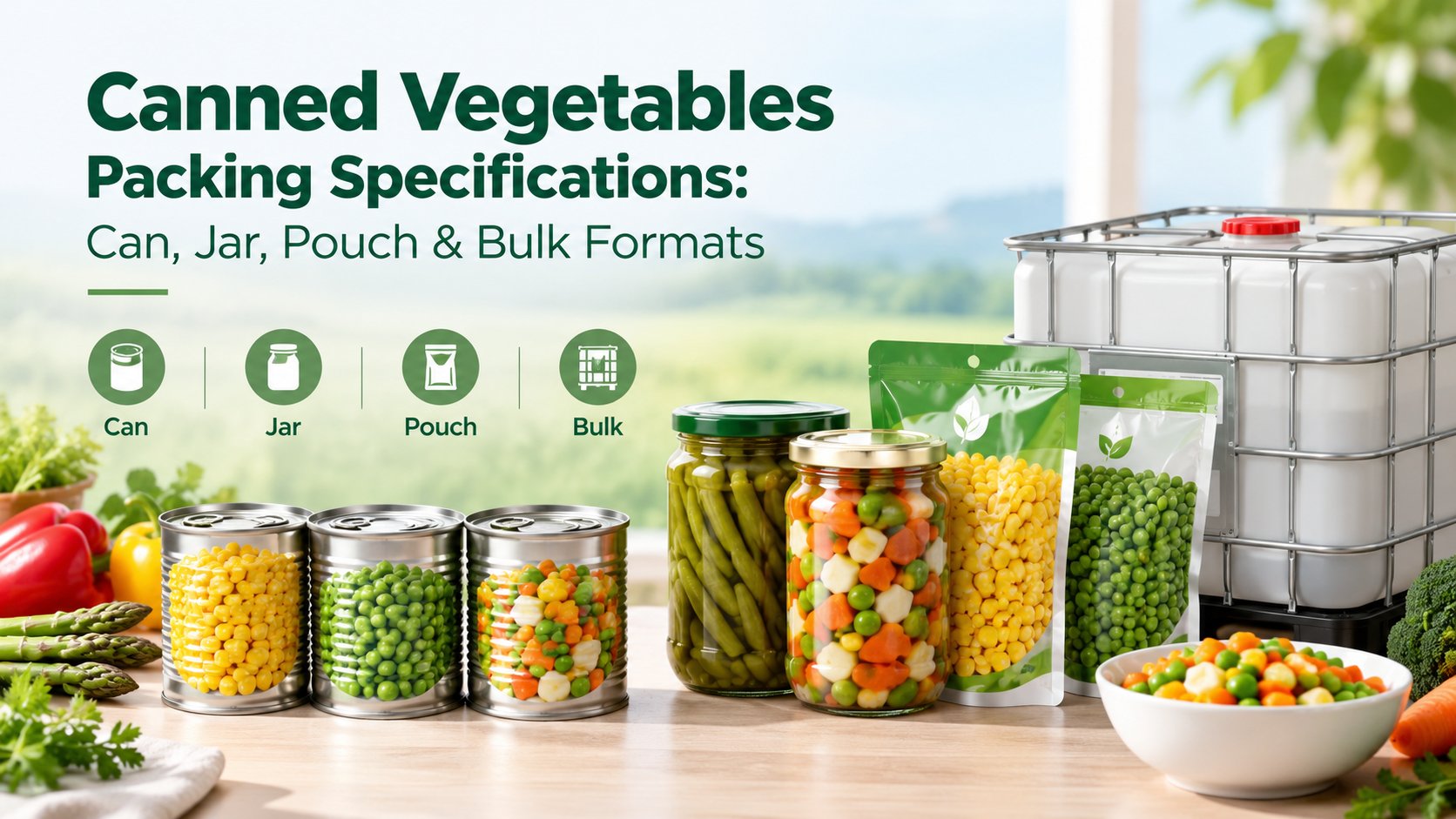
Main Canned Vegetable Packaging Formats
Canned and shelf-stable vegetables are commonly supplied in four broad formats:
Metal Can
Glass Jar
Retort Pouch
Bulk / Foodservice
Each format serves a different commercial purpose. Packaging should always be evaluated together with the target market and sales channel.
Metal Can Packaging for Canned Vegetables
Metal cans remain one of the most established formats for shelf-stable vegetables and are commonly used for asparagus, sweet corn, mushrooms, sweet peppers, peas, spinach, potatoes, baby corn, beetroot, and mixed vegetables.
Key Advantages of Metal Cans
Durability against impact and compression during transportation
Excellent stackability in cartons, warehouses, pallets, and containers
Well-established for commercial thermal processing
High retail familiarity among consumers
Size flexibility from small retail to large foodservice packs
Buyers should specify packages using commercially meaningful information: Net Weight + Drained Weight + Can Size + Closure Type. Example: 425 g can (approx. 15 oz), Net Weight 425 g, Drained Weight 235 g.
Common Canned Vegetable Can Sizes
The appropriate size depends on the target channel and consumption occasion. Typical formats include:
7oz (200g) – Small retail, drained ~125 g
8.8oz (250g) – Retail, drained ~150 g
10oz (280g) – Retail, drained ~185 g
15oz (425g) – Mainstream retail, drained ~235 g
15oz (430g) – Mainstream retail, drained ~270 g
28oz / 29oz (800g / 820g) – Family / foodservice
88oz / 106oz (2.5 kg / 3 kg) – Foodservice / bulk
Suppliers can provide both metric and US customary measurements (1 oz ≈ 28.35 g) for international buyers.
Net Weight vs. Drained Weight
One of the most important specifications is the difference between net weight and drained weight.
What is Net Weight?
Net weight is the total contents of the container (vegetables + packing medium such as water, brine, juice, or sauce).
What is Drained Weight?
Drained weight is the weight of the solid vegetable portion after the packing liquid has been removed according to the applicable testing procedure.
Metal Can Closure Options
Depending on the product and target market, closures may include standard ends, easy-open ends, or necked-in easy-open ends. Easy-open packaging improves retail convenience; foodservice buyers often prioritize strength, cost, and handling. For private-label projects, the closure should be specified during the packaging development stage.
Glass Jar Packaging for Canned Vegetables
Glass jars offer product visibility—allowing consumers to see color, shape, size, uniformity, packing arrangement, and liquid clarity before purchase. This is particularly valuable for white or green asparagus, whole mushrooms, sweet peppers, pickled vegetables, and specialty products.
Common Glass Jar Capacities
212 ml – Net ~180 g, Drained ~110 g (Retail)
250 ml – Net 180–190 g, Drained ~110 g (Retail)
314 ml – Net ~280 g, Drained ~170 g (Retail)
370 ml – Net ~330 g, Drained ~205 g (Retail)
580 ml / 720 ml – Family / retail
1,700 ml – Foodservice / large format
Note: Container capacity (ml) does not equal product net weight. Always request actual net and drained weights.
Retort Pouch Packaging
A retort pouch is a multilayer flexible package designed to withstand thermal processing after filling and sealing. It is not a conventional plastic bag. High-barrier structures may incorporate EVOH for oxygen barrier performance.
Advantages of Pouch Packaging
Lower packaging weight and transportation cost
Convenient handling and efficient storage
Flexible package design
Good suitability for convenience-oriented products
Pouches require careful control of seal integrity, puncture resistance, barrier performance, and retort compatibility. Request the complete pouch specification rather than simply asking if a supplier offers “pouch packaging.”
Bulk & Foodservice Packaging
Bulk packaging refers to large-format sealed packs (commonly 2.5 kg or 3 kg) designed for restaurants, hotels, catering, central kitchens, foodservice distributors, and industrial users. The purchasing focus shifts from price per consumer unit to cost per kilogram of usable vegetables—making drained weight and case yield especially important.
Retail Focus
Foodservice Focus
International Shipping & Logistics Considerations
Packaging affects product weight + packaging weight + case dimensions + pallet configuration + container utilization. Glass jars offer visibility but are heavy; metal cans provide protection and stacking strength; pouches reduce weight but need puncture protection. The lowest packaging material cost does not always produce the lowest total landed cost.
Complete Specification Should Include
Primary packaging (can/jar/pouch, net & drained weight, closure)
Secondary packaging (units per case, carton dimensions, gross weight)
Logistics (cases per pallet, pallets per container, cases per 20’/40’ FCL)
Private-Label Packaging Requirements
Private-label buyers must define packaging much earlier. A complete private-label specification typically covers product details, primary packaging, branding (label, barcode, closure color), secondary packaging, MOQ, artwork requirements, sample approval, and production lead time.
How Packaging Differs by Vegetable
Canned Asparagus
Spear length, diameter, grade, color, cut style, drained weight, container dimensions, and packing arrangement are critical. Both metal cans and glass jars are used.
Canned Sweet Corn
Whole kernel or cut style, net & drained weight, packing medium, retail or foodservice size.
Canned Mushrooms
Whole or sliced, piece size, net & drained weight, packing medium, retail or foodservice format.
Canned Sweet Peppers & Potatoes
Cut style (whole, sliced, strips, diced) must match packaging space; drained weight and large-format yield are especially important for foodservice.
How to Select the Right Packaging
Metal Can – Conventional format, durability, stacking, retail familiarity, both retail & foodservice needed
Glass Jar – Product visibility, premium positioning, shelf presentation critical
Retort Pouch – Lightweight, convenience, storage efficiency, validated structure & process available
Bulk / Foodservice – High volume, yield priority, restaurants/caterers/manufacturers, cost per kg focus
What Buyers Should Ask Suppliers
Before requesting a final quotation, request a complete packaging specification covering:
Product name, variety, cut/style, grade, net weight, drained weight, filling medium
Primary packaging type, capacity, dimensions, material, closure, labeling options
Units per case, case dimensions, gross weight, carton material, pallet configuration
Cases/pallets per container, loading weight for 20’ and 40’ FCL
MOQ, custom packaging options, artwork, lead times
Packaging Specification Checklist
Packaging Type – Product protection & positioning
Net Weight – Total product contents
Drained Weight – Usable vegetable quantity
Container Capacity & Closure – Format & convenience
Units per Case & Case Dimensions – Case economics & warehousing
Gross Case Weight & Pallet Configuration – Logistics efficiency
Container Loading – Freight economics
MOQ, Private Label Options, Shelf Life – Feasibility & inventory planning
Frequently Asked Questions
What are the main packaging types?
Metal cans, glass jars, retort pouches, and large-format foodservice packs.
What is the difference between net weight and drained weight?
Net weight includes vegetables + packing liquid; drained weight is the solid vegetable portion after draining.
What is a standard retail can size?
Common formats are approximately 200 g, 250 g, 280 g, and 425–430 g (roughly 7–15 oz).
How many ounces in a 425 g can?
Approximately 15 oz by weight.
Are vegetables available in glass jars?
Yes. Common capacities range from about 212 ml to 1,700 ml.
What is a retort pouch?
A multilayer flexible package designed to withstand commercial thermal processing after filling and sealing.
What sizes are used for foodservice?
Typically 800 g to 3 kg; 2.5 kg and 3 kg formats are common for high-volume use.
How should buyers compare suppliers?
Compare net weight, drained weight, price per usable kilogram, packaging type, case pack, logistics data, MOQ, certifications, and private-label capability—not only price per can.
Ready to source the right canned vegetable packaging?
The best packaging format balances product protection, usable yield, shelf presentation, consumer convenience, logistics efficiency, processing requirements, and total landed cost. Evaluate packaging together with the product specification and supply-chain requirements from the start.
Final Takeaway
Canned vegetable packaging is a procurement decision, not simply a container choice. Metal cans deliver durability and familiarity; glass jars deliver visibility and premium appeal; retort pouches deliver lightweight convenience; bulk formats maximize yield for foodservice. Among all specifications, drained weight deserves particular attention because it reveals the actual quantity of vegetables delivered.
For international buyers, the most important specifications are: Packaging Format + Net Weight + Drained Weight + Container Size + Closure + Case Pack + Pallet Configuration + Container Loading.