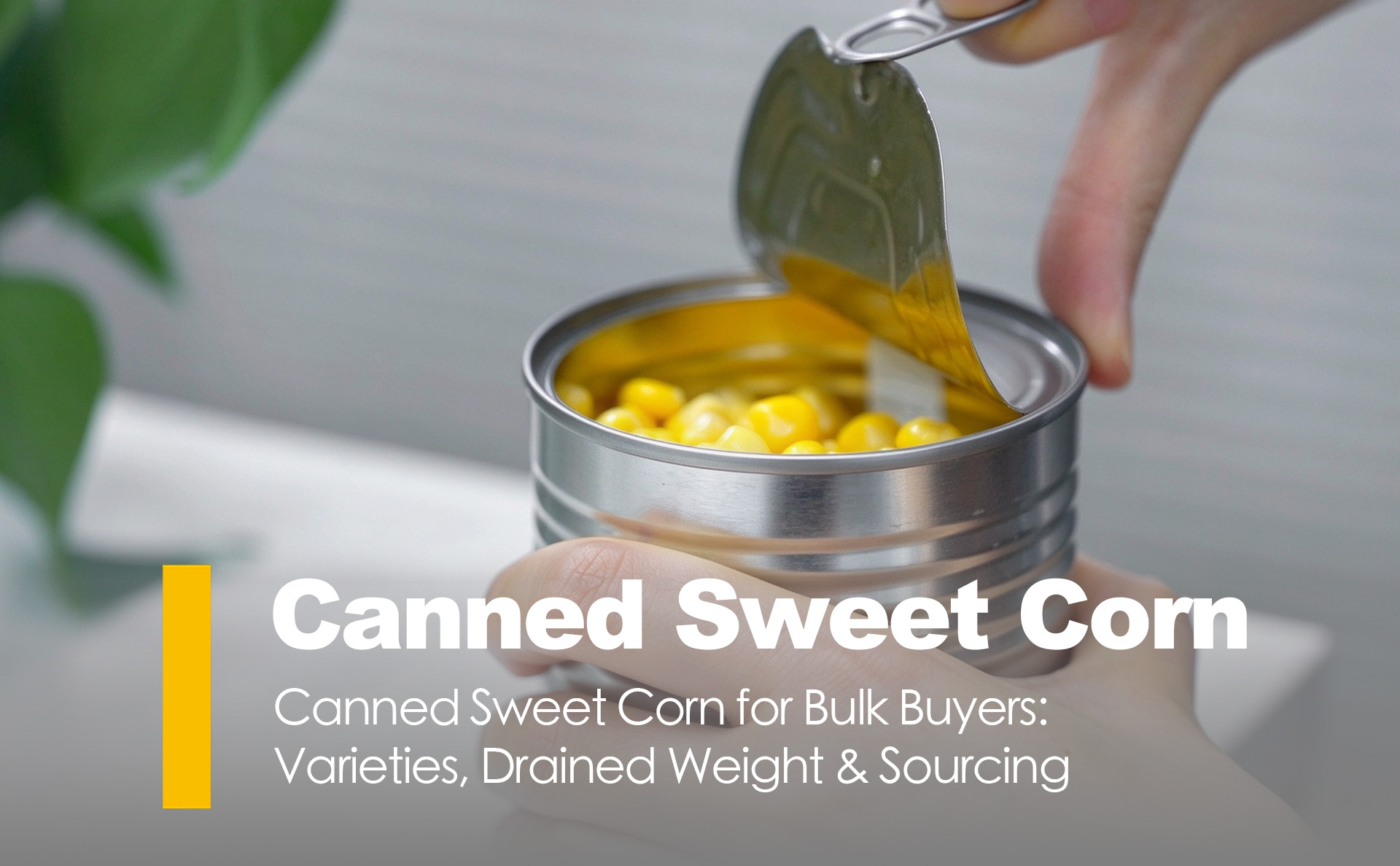


When purchasing canned sweet corn—whether buying a single 15 oz can for a family dinner or importing commercial 106 oz cans by the pallet—understanding the numbers on the label is essential for getting true value. Two primary metrics define the contents of any canned food: Net Weight and Drained Weight. While they sound similar, conflating the two can lead to unexpected cooking results, menu calculation errors, or substantial procurement budget discrepancies.
In this guide, we break down the exact differences between Net Weight and Drained Weight using real-world specifications from Countree Food, a leading global manufacturer of canned fruits and vegetables. We will cover calculation examples across common sizes (from 8 oz to 106 oz), explore modern packaging formats like soft pouches, and provide practical sourcing advice for both business buyers and consumers.
Defining the Terms: Gross, Net, and Drained Weight
To understand how canned sweet corn is measured, let us look at the three weight categories involved in food manufacturing:
Gross Weight: The total weight of the unopened product, including the container (tin can, lid, label), liquid brine, and corn kernels.
Net Weight: The total weight of the contents inside the container, excluding the metal can or packaging material.
Net Weight = Solid Corn Kernels + Liquid BrineDrained Weight: The actual weight of the solid corn kernels remaining after all the liquid brine has been completely drained according to standardized testing methods (e.g., draining over a standard sieve for 2 minutes).
Drained Weight = Net Weight − Liquid Brine Weight
Why Drained Weight Matters (The Filling Ratio)
The ratio between Drained Weight and Net Weight is known as the filling ratio or drained weight yield percentage:
Drained Weight Yield (%) = (Drained Weight / Net Weight) × 100
Why is this ratio critical?
For Culinary Accuracy: Recipes call for a specific volume or weight of actual corn kernels, not corn water. Knowing the exact drained weight ensures consistent taste, texture, and yield in commercial kitchens and home recipes.
For Cost Transparency: A lower price per unit does not always mean a cheaper product. If Can A has a 60% drained weight ratio and Can B has a 70% ratio, Can B actually offers more edible food per dollar, even if their Net Weights are identical.
For Quality Control: In industrial food processing, consistent drained weight indicates uniform vacuum sealing, precise automated fill lines, and proper thermal processing that prevents excessive kernel shrinkage.
Specifications & Calculations across Common Packaging Sizes
Countree Food manufactures canned sweet corn in standard rigid tin cans as well as flexible vacuum packs and soft pouches. Below is a detailed breakdown of specifications, drained weight yields, and practical applications across popular sizes.
Standard Canned Sweet Corn Specifications Table
Packaging Size Comparison
8 oz(220g) — Rigid Can / Vacuum | Target Net ~220g | Drained ~140–160g(adjustable per customer requirements) | Yield ~60%–70% | Single-serve meals, snack salads
12 oz (340g) — Standard Can / Vacuum | Net 340g | Drained ~250–285g(adjustable per customer requirements) | Yield ~73%–84%* | Retail grocery, small households
15 oz (425g) — Standard Can | Net 425g | Drained ~250–275g(adjustable per customer requirements) | Yield ~58%–65% | Standard retail shelf size
29 oz (800g) — Medium Can | Net 800g | Drained ~460–500g(adjustable per customer requirements) | Yield ~56%–60% | Family-size packaging, small catering
106 oz (3kg / #10 Can / A10) — Commercial Tin | Net ~3000g | Drained ~1800–1850g(adjustable per customer requirements) | Yield ~60%–62% | Foodservice, restaurants, hotels
106 oz Soft Pouch — Flexible Retort Pouch | Net ~3000g | Drained ~2100–2400g(adjustable per customer requirements) | Yield ~70%–80%+ | Modern institutional foodservice
*Note: Vacuum-packed sweet corn requires significantly less liquid brine during processing, yielding a substantially higher drained weight percentage relative to total net weight. In addition, the drained weight of dry-packed tin cans is also very high.
Real-World Calculation Examples
Example 1: B2B Foodservice Cost Comparison (#10 Can vs. 106 oz Soft Pouch)
A commercial kitchen manager needs 100 kg of pure sweet corn kernels per week for salad preparation and menu items. They are deciding between traditional #10 cans and modern 106 oz flexible soft pouches.
Option A: Traditional #10 Can (106 oz)
Net Weight per can: 3,000 g
Drained Weight ratio: 60% (1,800 g usable corn per can)
Cans needed: 100,000 g ÷ 1,800 g/can ≈ 56 cans
Option B: Retort Soft Pouch (106 oz Vacuum/Low-Brine)
Net Weight per pouch: 3,000 g
Drained Weight ratio: 75% (2,250 g usable corn per pouch)
Pouches needed: 100,000 g ÷ 2,250 g/pouch ≈ 45 pouches
Key Takeaway: Despite both formats being labeled as “106 oz,” the soft pouch format yields 25% more usable corn per unit. This significantly lowers shipping weights, reduces kitchen storage space, and minimizes packaging disposal fees.
Example 2: Retail Consumer Value Analysis (15 oz Standard vs. 12 oz Vacuum Pack)
A consumer is comparing two cans on a grocery shelf:
Can A (Standard 15 oz / 425g Can): Priced at $1.20. Claims Net Weight of 425 g with a standard 60% drained weight (255 g corn).
Cost per 100g usable corn = ($1.20 / 255 g) × 100 = $0.471 per 100g
Can B (Vacuum Pack 12 oz / 340g Can): Priced at $1.20. Claims Net Weight of 340 g with an 80% drained weight (272 g corn).
Cost per 100g usable corn = ($1.20 / 272 g) × 100 = $0.441 per 100g
Key Takeaway: Even though Can A appears larger based on total Net Weight (15 oz vs 12 oz), Can B gives you more actual food for the same price because vacuum-packed cans require less packing brine.
Modern Packaging Innovations: Standard Cans vs. Vacuum Packs vs. Soft Pouches
The evolution of food preservation technology has changed how sweet corn is packaged and traded globally.
Traditional Rigid Canned Corn
(8 oz, 15 oz, 29 oz, 106 oz)
Kernels are submerged in liquid brine (water, salt, and sometimes sugar) to facilitate even heat transfer during retort sterilization.
Drained Weight Ratio: Typically 58% – 65%.
Pros: Extremely long shelf life, highly durable, stackable, cost-effective standard production lines.
Vacuum-Packed Sweet Corn
(8 oz, 12 oz / 340g)
Corn is packed with a minimal amount of liquid brine and air is evacuated from the container before sealing. Heat sterilization relies on steam.
Drained Weight Ratio: High yield, often 75% – 85%.
Pros: Retains a crispier texture and vibrant golden color. Less liquid means lower freight costs per pound of actual food.
Flexible Retort Soft Pouches
(e.g., 106 oz / 3kg)
Multi-layer laminate bags replace metal cans.
Drained Weight Ratio: High yield, typically 70% – 80%+.
Pros: Freight efficiency (significantly reduces packaging tare weight), safety (eliminates sharp metal edges), ease of use (quick-tear opening, easier waste disposal).
Practical Guide: Advice for B2B Procurement & Retail Consumers
For B2B Buyers & Importers (Distributors, Foodservice, Private Label)
Specify Drained Weight in Contracts, Not Just Net Weight
When placing bulk purchase orders or negotiating private label manufacturing with suppliers like Countree Food, always define the required Drained Weight minimums alongside Net Weight specifications to prevent quality variance between batches.Audit Sieve Testing Standards
Ensure your supplier adheres to recognized international inspection standards (such as Codex Alimentarius or FDA standards) for measuring drained weight using standardized mesh sieves and official 2-minute drain times.Evaluate Logistics Costs Based on Usable Yield
Shipping water across ocean freight is costly. Choosing higher yield options like 12 oz vacuum cans or 106 oz soft pouches optimizes shipping container weight limits by maximizing the amount of solid corn payload delivered per TEU.Choose Super Sweet Corn Varieties
Verify that your manufacturer uses naturally crisp super sweet corn varieties. Crisp kernels absorb less excess water during sterilization, retaining their weight and crisp mouthfeel after draining.
For Everyday Consumers
Check the Fine Print on the Back Label
While the front label prominently displays the Net Weight (e.g., “15 oz”), the back nutritional and specification panel usually lists the serving size and drained yield.Don’t Waste the Brine
If you purchase traditional canned corn with liquid brine, remember that the canning liquid contains soluble B vitamins, minerals, and natural sweet corn flavor. Use it as a flavorful stock base for corn chowder, soups, or as cooking liquid for rice and grains.Match the Package to the Occasion
Single Salads / Quick Meals: Opt for 8 oz or 12 oz vacuum packs to avoid food waste.
Family Baking & Side Dishes: Standard 15 oz cans provide ample kernels plus liquid that can be incorporated directly into cornbread or casserole batters.
Conclusion
Understanding the difference between Net Weight and Drained Weight is the single most effective way to evaluate the true value and quality of canned sweet corn. While Net Weight measures everything inside the container, Drained Weight reveals the true amount of wholesome sweet corn kernels you are paying for.
By offering a versatile lineup of specifications—from traditional 8 oz, 15 oz, 29 oz, and 106 oz cans to high-yield 12 oz vacuum packs and modern 106 oz soft pouches—manufacturers like Countree Food empower importers, restaurant operators, and consumers to select the ideal packaging and yield for their specific operational needs.
Ready to explore premium canned sweet corn solutions?
Partner with Countree Food—the global leader in high-yield canned and pouched sweet corn.
View Our Complete Product Range