

A can of fruit cocktail may look like a simple combination of fruit in syrup or juice. For a retail buyer, however, bringing that product to market involves several decisions: which fruits to include, what liquid medium to use, how much product each pack should contain, and how the finished product should be presented on the shelf.
These choices affect more than the product itself. They shape its positioning, packaging costs, target consumers, and suitability for different retail channels.
For importers, supermarket buyers, and private label brands, developing a canned fruit cocktail for retail requires the fruit blend, formulation, packaging specifications, and purchasing requirements to work together.
1. Start with the Fruit Mix, Not the Can
Fruit selection is one of the first decisions in developing a canned fruit cocktail for retail. Different combinations create different colors, textures, and flavor profiles, giving buyers a practical starting point for building a product range.
Two common development directions are a classic mixed fruit cocktail and a tropical fruit blend.
Classic Fruit Cocktail: A Familiar Combination
A classic fruit cocktail typically combines several fruits with complementary colors, textures, and flavors. One familiar five-fruit combination includes:
Peach
Pear
Grape
Pineapple
Cherry
This type of blend brings together different fruit textures and colors to create a varied mixed-fruit appearance. The specific fruits and proportions can be adjusted to suit the target market, cost requirements, and product positioning.
For retailers, a classic blend can be one option within a traditional canned fruit range. It may also serve as a starting point for private label development when a brand wants a familiar mixed-fruit product.
During development, buyers should confirm fruit proportions, piece sizes, appearance requirements, and any specific requirements for individual ingredients with the supplier.
Tropical Fruit Cocktail: A Different Product Direction
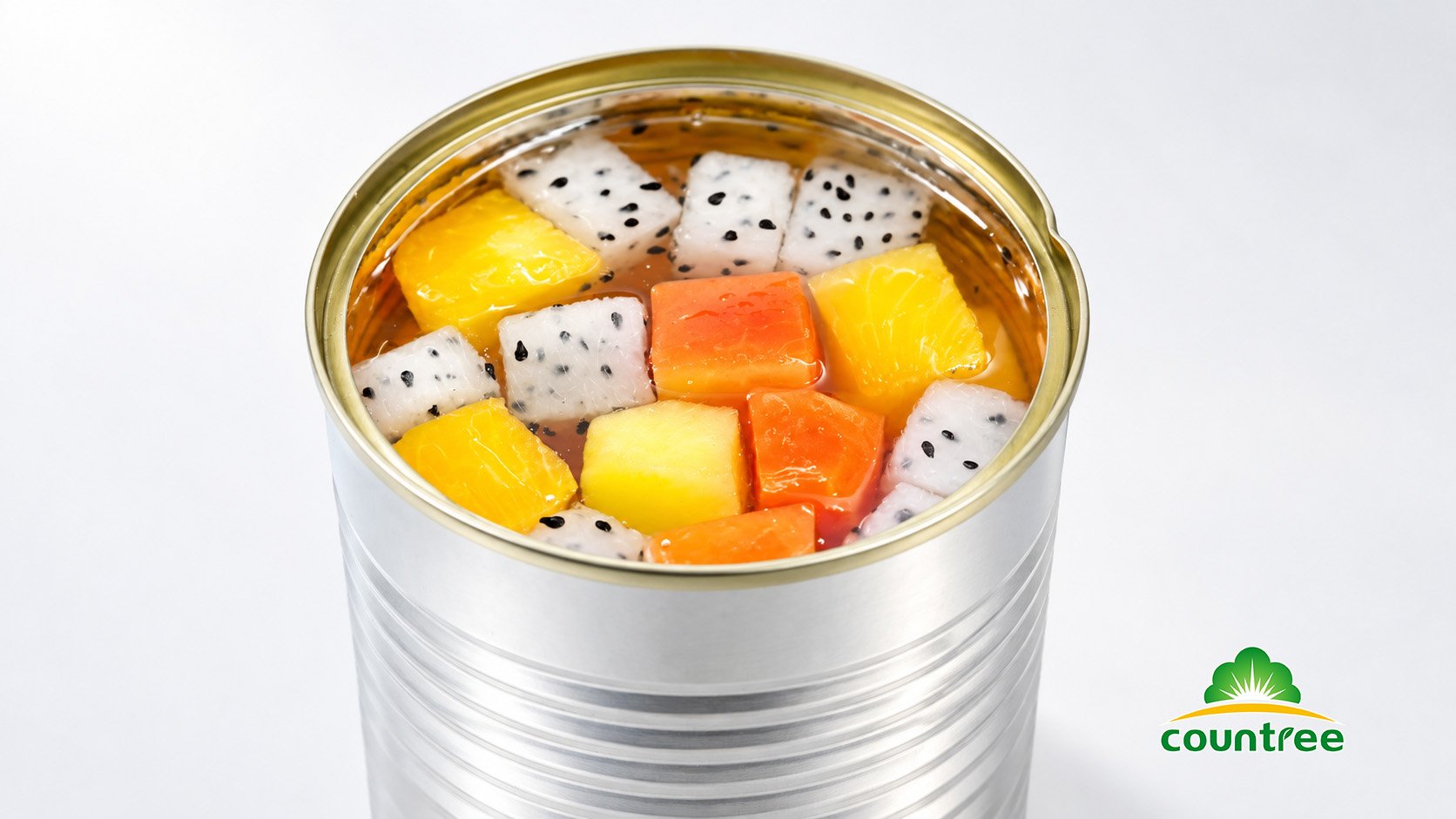
For brands looking for a tropical flavor profile, a blend featuring peach, pineapple, and papaya is one option.
Compared with a broader classic blend, a tropical-style combination can create a different balance of color, texture, and flavor, offering another direction for a retail range.
The choice between a classic and tropical-style fruit cocktail should reflect the intended product range and target consumers, rather than being only a difference in product naming. These combinations are examples, not universal formulas. The final fruit selection, proportions, and specifications should be agreed upon during product development.
2. Choose the Liquid Medium to Match the Product Positioning
Fruit determines the main contents of a fruit cocktail, but the packing liquid also affects sweetness, flavor, and overall positioning.
Depending on the formulation, canned fruit cocktail may be packed in syrup, fruit juice, water, or developed as a reduced-sugar option.
Fruit Cocktail in Syrup
Syrup is a common option for canned fruit cocktail. Buyers should define the desired sweetness level rather than treating all syrup-packed products as the same. Brix can be used as one reference point when discussing a formulation, but the target should be determined by the fruit blend, recipe, and product requirements instead of applying one fixed value to every product.
When comparing options, buyers should confirm the syrup formulation, ingredient declaration, and sensory profile of the finished product.
Fruit Cocktail in Juice
For brands seeking an alternative to conventional syrup, a fruit juice medium may be considered. Pear juice, white grape juice, and pineapple juice are possible options, depending on the intended flavor and formulation.
Before approving a recipe, buyers should confirm the juice source, actual formulation, and ingredient-labeling requirements. Using fruit juice does not mean all products will have the same sweetness or nutritional profile; the final result depends on the recipe and ingredient proportions.
Fruit Cocktail in Water or a Reduced-Sugar Formulation
Water-packed products and reduced-sugar formulations may also be considered by brands exploring alternatives to traditionally sweetened fruit cocktail. Depending on the recipe and destination-market requirements, a non-sugar sweetener may be another option.
These approaches are not interchangeable. Each requires a clearly defined ingredient specification and must meet the applicable food-labeling requirements of the target market.
Before choosing a packing medium, buyers can start with three questions:
What sweetness level fits the intended product?
Which ingredients need to be declared on the label?
Does the formulation meet the requirements of the destination market?
Resolving these questions early can help avoid changes to the formulation or label after packaging artwork has been prepared.
3. Match the Packaging to the Retail Format
Packaging decisions should start with the intended sales format, not simply with the containers available from a manufacturer.
A product designed for family consumption may require a different pack size and opening experience from one intended for an individual serving. Retailers launching private label products may also have specific requirements for shelf presentation and label design.
Metal Cans
Glass Jars
Fruit Cups & Small Packs
Not every fruit cocktail formulation is suitable for every packaging format. The product, container, closure, and filling process should be checked together with the manufacturer.

4. Specify Net Weight and Drained Weight Separately
One detail that deserves attention in canned fruit procurement is the difference between net weight and drained weight. Net weight generally refers to all product contents, including fruit and packing liquid. Drained weight refers to the solid contents remaining after the liquid has been removed according to the applicable measurement method.
For fruit cocktail, this distinction matters because two products with similar net weights may contain different amounts of fruit. When comparing supplier quotations, buyers should confirm both figures rather than relying on net weight alone.
A practical product specification should identify:
Fruit varieties and the agreed blend
Fruit piece size and appearance requirements
Packing medium and target sweetness
Net weight and drained weight
Container type and pack dimensions
Units per retail pack and per shipping carton
Label language and required declarations
These details give buyers and suppliers a shared basis for evaluating samples, approving production, and comparing quotations.
5. Develop Private Label Fruit Cocktail Around Your Requirements
Private label development is not limited to putting a retailer’s logo on an existing product. A more useful starting point is to identify which product characteristics can follow a standard specification and which need to be customized.
For a fruit cocktail project, buyers may need to discuss the fruit blend, packing medium, sweetness level, container format, pack size, and label artwork.
For example, one retailer may want a classic fruit blend in syrup, while another may prefer a tropical-style combination with a different packing medium. Both projects need a clear product specification, even if they appear similar at first.
Packaging artwork also requires early coordination. Label dimensions depend on the selected container, while ingredient declarations and other required information depend on the final formulation and destination market.
Before confirming a private label order, buyers should align on:
The approved product recipe and sample
The container, pack size, net weight, and drained weight
The label artwork and destination-market requirements
The quotation, order quantity, and production schedule
The required export documents and shipping arrangements
This approach keeps product development, packaging approval, and order execution connected rather than treating them as separate tasks.
6. What Retail Buyers Should Check Before Placing an Order
A competitive quotation is only one part of a sourcing decision. Buyers also need to understand whether the product specification, production schedule, and export arrangements are realistic.
Confirm the Complete Cost
When comparing canned fruit cocktail suppliers, make sure each quotation refers to the same product specification. Fruit composition, packing liquid, packaging format, net weight, drained weight, and carton configuration can all affect the final price.
Import duties, required certificates, additional documentation, and other destination-specific costs should also be considered when calculating landed cost. A lower unit price does not necessarily mean a lower total cost if the packaging or shipping configuration differs.
Agree on the Production and Packaging Schedule
Fruit production may be affected by seasonal raw material availability, while packaging materials and label approval also require time. The order timeline should therefore be discussed before a delivery date is promised.
Buyers should confirm raw material availability, production arrangements, packaging readiness, and the time needed for final shipment preparation. For customized orders, agree on milestones in advance and follow progress through production and packaging. The actual lead time should be confirmed for each product and order.
Check Destination-Market Requirements
Import requirements vary by market and product. Depending on the destination, buyers may need to verify applicable food-labeling rules, ingredient declarations, export documents, and certification requirements.
These details should be confirmed before the order is finalized, particularly for products with customized formulations or retailer-specific packaging.
Agree on Payment and Order Terms
Payment arrangements should reflect the buyer relationship, order structure, and commercial risk. For highly customized products—especially those with packaging printed with the buyer’s trademark—the parties should agree in advance on payment terms, approval responsibilities, and how dedicated packaging materials will be handled.
Clear order terms can reduce misunderstandings after production begins and help manage the risk associated with packaging that cannot easily be used for other orders.
7. Build a Clear Product Brief Before Contacting Suppliers
Efficient sourcing conversations usually start with a clear product brief rather than a general request for a price.
If you are developing canned fruit cocktail for a supermarket, food distributor, or private label brand, start by identifying the following:
Target market: Which country or region will the product be sold in?
Fruit mix: Are you looking for a classic combination or a tropical-style blend?
Packing medium: Do you prefer syrup, fruit juice, water, or another formulation?
Packaging format: Do you need metal cans, glass jars, or single-serving fruit cups?
Pack specification: What are the target net weight, drained weight, and units per case?
Private label requirements: Do you need customized labels, packaging artwork, or specific ingredient declarations?
Order requirements: What are the expected order quantity, delivery timeline, and documentation needs?
You do not need to finalize every detail before contacting a supplier. However, the clearer your core requirements are, the easier it becomes to assess feasibility, compare proposals, and move toward sample approval.
For retail markets, the right fruit cocktail is not necessarily the one with the most fruit varieties or the most elaborate packaging. It is the product whose fruit blend, sweetness, packaging specifications, and price positioning work together.

The Right Canned Fruit Cocktail Solution
The right canned fruit cocktail solution starts with a clear understanding of your market, your product requirements, and your retail goals.
Before finalizing a formulation or package, define who the product is for, how it will be sold, and which purchasing requirements it must meet. That foundation makes product development and order execution more straightforward.
Ready to develop your canned fruit cocktail for retail?
Partner with Countree Food for consistent quality, flexible formulations, and reliable supply tailored to your market.
Explore our Canned Fruit Cocktail range