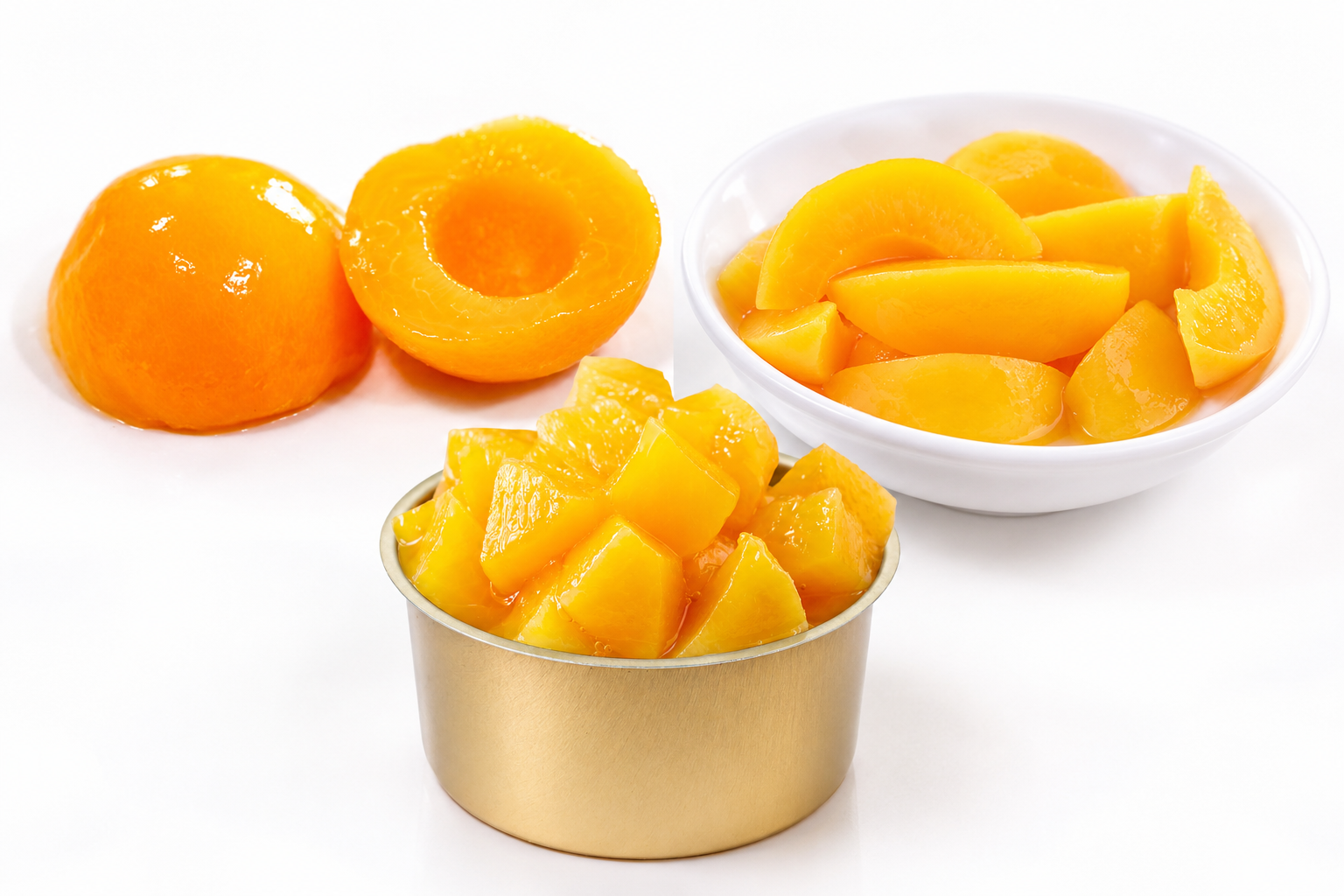


In the global canned fruit and fruit cup sector (including prominent SKUs such as peach halves, slices, and diced cups exported to major European and North American retail chains like Lidl, Edeka, Aldi, Rewe, and Carrefour), one of the most foundational product formulation choices is the packing medium.
Choosing between traditional syrup (sugar syrup) and 100% fruit juice dictates not only production costs and logistics, but also regulatory compliance, nutritional grading (such as the EU Nutri-Score), and brand positioning. This guide provides B2B importers, private label brand owners, and foodservice distributors with an in-depth comparative analysis to optimize sourcing and product development.

1. Executive Summary & Market Context
Market Dynamics: The choice between syrup and juice packing mediums fundamentally influences cost structures, shelf-life performance, labeling claims, and market positioning across global retail and industrial channels.
This B2B guide delivers a practical framework for procurement managers and product developers to select the optimal packing medium based on end-use application, regulatory requirements, and commercial strategy.
2. Technical & Supply Chain Core Comparison
Understanding the chemical and operational properties of each packing medium is essential for quality control and shelf-life management.
| Technical / Commercial Parameter | Canned Peaches in Syrup | Canned Peaches in Juice |
|---|---|---|
| Packing Medium Ingredients | Water, sucrose, glucose-fructose syrup (Brix ranges: Light 10-14%, Heavy 14-18%) | 100% reconstituted fruit juice (White grape, apple, or pear juice concentrate, Brix 10-14%) |
| Brix & Osmotic Pressure | High osmotic pressure; sugar penetrates fruit tissue, firming texture and preserving cellular integrity. | Moderate osmotic pressure; maintains natural fruit cellular structure and authentic fresh orchard flavor. |
| Manufacturing Cost | Lower raw material cost (refined sugar/glucose syrup is economical; standard processing yield). | Higher raw material cost (pure fruit juice concentrate increases BOM cost by 15-25%). |
| Shelf Life & Stability | Extremely stable; high sugar content acts as an antimicrobial buffer; exceptional resistance to thermal degradation. | Stable under standard commercial sterilization, but requires strict control over concentrate pH and soluble solids. |
| Primary B2B Application | Industrial baking, pastry manufacturing, food service catering, mainstream discount retail. | Premium private label retail, school nutrition programs, health-focused snack channels, DTC brands. |

3. Regulatory Framework & Labeling Compliance
Navigating international export markets requires strict adherence to regional labeling standards and nutritional profiling systems.
Labeling Claims & Compliance: Under FDA (USA) and EU Regulation (EU) No 1169/2011, marketing claims on canned fruit must strictly reflect the packing medium:
Products packed in fruit juice can legally feature claims such as “No Added Sugar” or “100% Fruit Juice”, provided no refined white sugar or artificial sweeteners are added.
These products still contain high levels of natural fruit sugars (fructose/glucose), which must be accurately reflected in the Nutrition Facts panel (Total Sugars).
Syrup-packed peaches must be designated as “In Heavy Syrup” or “In Light Syrup”, accompanied by mandatory declaration of added sugars.
4. End-Use Applications & B2B Channel Strategy
B2B procurement managers must align the packing medium with the downstream processing or retailing channel requirement.
Industrial & Food Service (HoReCa)
For industrial baking, pastry manufacturing, and large-scale food service (HoReCa), syrup-packed peaches are the preferred choice. The high sugar concentration prevents the fruit from breaking down during extended baking cycles, retains moisture in pies and tarts, and provides desirable caramelization properties during roasting.
Retail & Private Label (DTC / Supermarket)
For retail fruit cups, convenience store single-serve packs, and organic/natural private label lines, juice-packed peaches dominate. Consumers in these segments demand clean labels, transparent ingredient decks (water and fruit juice only), and a lighter, more refreshing taste profile that mirrors fresh-cut fruit.
5. Strategic Sourcing & Procurement Recommendations
Procurement Checklist: When issuing RFQs or auditing OEM/ODM suppliers for canned peach production, procurement teams should evaluate the following criteria:
Juice Authenticity: Verify that juice-packed lines utilize 100% genuine fruit juice concentrate (e.g., clarified white grape or apple juice) rather than diluted water-sugar mixtures flavored with juice extracts.
Brix Consistency: Establish strict tolerance limits for drained weight (DW) and syrup/juice Brix levels to prevent product rejection at destination ports.
Supply Chain Flexibility: Partner with processing facilities that can offer dual-line capabilities—enabling seamless switching between light syrup, heavy syrup, 100% juice, and water packs based on shifting regional demand.
Ready to source the right canned peaches for your market?
Partner with Countree Food for high-quality canned peaches in syrup or 100% juice, tailored to your technical specifications and target channels.
Explore Our Canned Peaches