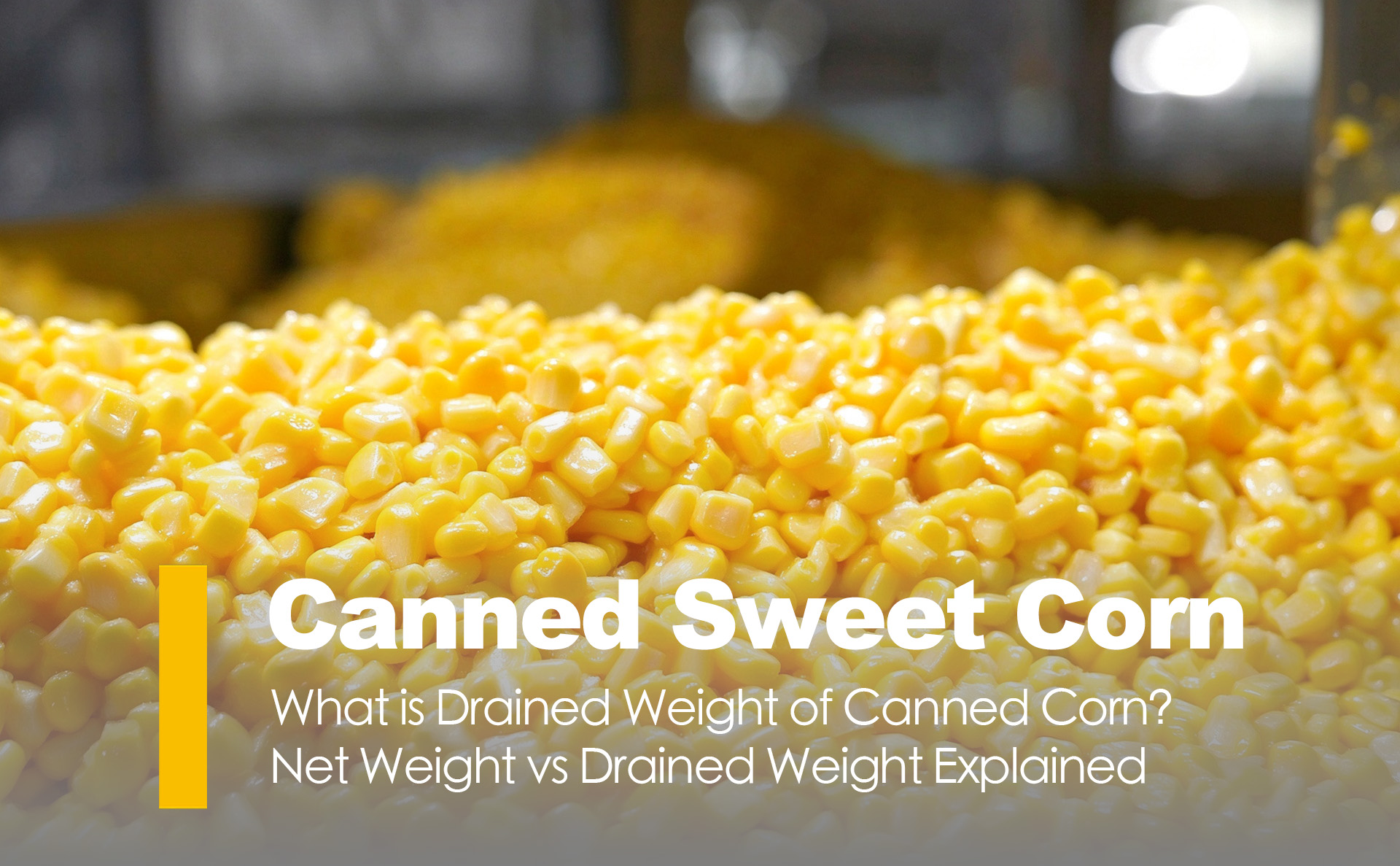


Ordering canned sweet corn from the wrong manufacturer is expensive: inconsistent drained weight, off-spec sweetness, delayed containers, labels that fail your market's inspection. This guide gives you the 7 checks professional importers run before placing a purchase order — from specifications and drained weight verification to certifications, landed cost, and private label depth.
1. Define Your Specification Before You Shop for a Factory
Most bad supplier experiences start with a vague brief. Before requesting quotes, lock in:
Kernel type: whole kernel vs. cream style (different lines, different pricing)
Sweetness: Brix level (typical canned sweet corn: 12–20°Bx for kernels packed in light syrup; lower for brine packs). Confirm how the factory measures and controls it batch to batch.
Can size:retail — 340g, 400g, 425g, 850g; foodservice — 2840g / A10 (see retail vs. foodservice can sizes). Confirm drained weight per size, not just net weight.
Packing medium: water, brine, or light syrup — affects taste, labeling, and duty treatment in some markets.
Lid type: easy-open vs. standard; some retail markets require EOE.
Suppliers quote accurately only when the spec is complete. Send a one-page specification sheet with your RFQ — factories that answer it line by line are the ones worth visiting.
2. Match Certifications to Your Target Market
Certificates are not decoration — they decide whether your container clears the port.
Baseline (any export market): HACCP, ISO 22000
EU / UK retail: BRCGS; supplier must also meet EFSA contaminant and labeling rules
US: FDA facility registration; be ready to provide prior-notice and FSVP documentation
Middle East / Southeast Asia: Halal certification (check which body your market recognizes)
Organic claims: EU organic / USDA NOP certificates covering the actual product, not just the facility
Ask for the certificate PDFs and check the scope line: it must cover canned sweet corn / canned vegetables and be within validity. A factory certified only for frozen vegetables cannot legally claim the certification for your canned line.
3. Verify Drained Weight, Not Just Net Weight
This is where margins quietly leak. Two factories can both sell "425g" cans with meaningfully different kernel content.
Ask for drained weight (g) per can size in writing, e.g. 425g can → ≥240g drained
Ask how they verify it: sampling plan, equipment, and whether the figure appears on the certificate of analysis (CoA)
Test it yourself on samples: drain 3 minutes over a standard sieve, weigh — and repeat across two production batches
If a supplier only quotes net weight and goes quiet on drained weight, treat that as a red flag.
4. Test Samples Across Batches, Not Just Once
One perfect sample proves nothing. Importers who skip multi-batch testing are the ones posting about "the second container tasted different."
Request samples from two separate production dates; compare kernel size uniformity, color, sweetness (Brix), and texture after draining
Ask for the CoA for each batch: microbiology, Brix, drained weight, salt content
If you run your own brand, test how the product performs in your retail packaging and shelf-life conditions
Factories with real process control welcome this. Factories that stall or substitute "equivalent" samples do not.
5. Calculate Landed Cost, Not Unit Price
The cheapest per-carton quote often loses once you add the rest:
Incoterms: compare FOB vs. CIF vs. EXW on equal footing
Cartons per 20FCL / 40HQ: packing density varies by can size and carton spec — ask for the loading plan, because fewer cartons per container raises your per-unit freight
Payment terms and lead time: a lower price with 60-day production during peak season can cost more in stockouts than a slightly higher price with reliable scheduling
Duties: confirm the HS code used on export docs — canned sweet corn is classified under HS 2005.80 — and check your market's applied duty rate before you commit
Build a simple landed-cost sheet per supplier. It is the only honest price comparison.For variety, drained-weight and sourcing details, see our guide to canned sweet corn for bulk buyers.
6. Check Seasonal Capacity and Lead Times
Sweet corn is a seasonal crop. Factories run hardest during harvest windows, and capacity gets allocated to whoever booked first.
Ask: which months are peak production, and what is the current order book for your spec?
Confirm production lead time (from artwork/label approval to ex-factory) and shipping schedule separately — "30 days" means nothing if it excludes label approval
Ask what happens if your reorder lands in peak season: do existing customers get priority, and how is that documented?
If you need year-round supply, confirm the factory packs across the full season or holds buffer stock of finished goods — and get the commitment in the contract, not in chat.Before committing volume, verify the manufacturer's stated production capacity and seasonal booking schedule in writing.
7. Factory or Trading Company — and How Deep Does Private Label Go?
Many "manufacturers" on sourcing platforms are trading companies. That is not automatically bad — but you must know which one you're dealing with, because it changes pricing, QC access, and accountability.
Ask for a video factory audit or third-party audit report (SGS / Bureau Veritas) naming the production site
Confirm the factory cans sweet corn itself — some facilities only pack or relabel
Private label depth: real private label is more than sticking your logo on a can. Ask whether they can do: custom can sizes, custom Brix/salt formulations, retail-ready packaging and barcodes, destination-market label compliance review, and — critically — spec consistency across reorders so your second container matches your first
Ordering canned sweet corn this season?
Request our specification sheet, FOB pricing for your market, and production samples — admin@countreefood.com. Qingdao Countree Food Co., Ltd. packs whole kernel and cream style sweet corn, certified IFS (higher level), BRC A+, HACCP, FDA, SQF and ISO 22000, with private label capability. Countree supplies retailer brands in 100+ countries, including canned corn under the Coles, ALDI, Auchan, EDEKA, SPAR and Dia labels.
View Our Complete Product RangeFrequently Asked Questions
What is the HS code for canned sweet corn?
2005.80 — sweet corn prepared or preserved (not frozen).
What drained weight should I expect in a 425g can?
It varies by factory; confirm the figure in writing and verify on samples.
What is the typical MOQ for private label canned sweet corn?
Confirm directly with the manufacturer (typically based on 1×20FCL per SKU).
How long is the shelf life of canned sweet corn?
Typically 3 years from production date when stored properly.
Whole kernel vs. cream style — which should I import?
Whole kernel dominates retail; cream style serves foodservice and specific regional cuisines. Decide by your channel, then brief the factory.
Ready to Source with Confidence?
Use these 7 checks to shortlist reliable canned sweet corn manufacturers and avoid costly mistakes. Partner with a proven exporter that combines global certifications, consistent quality, and true private-label capability.