

How to Choose the Right Can Size for Retail vs Foodservice

How to Choose the Right Can Size for Retail vs Foodservice

news_banner

How to Choose the Right Can Size for Retail vs Foodservice

28th September, 2026

Choosing the right can size is more than a packaging decision. For canned fruit buyers, the wrong format can affect retail pricing, portion control, food waste, storage, and ultimately the cost of each serving.

A can size that works well for a supermarket shelf may not be the right choice for a restaurant, hotel, bakery, or catering operation. Retail consumers often prioritize convenience and household consumption, while foodservice buyers are more concerned with yield, labor efficiency, and how much product can be used after opening.

So, how do you choose the right can size? The answer starts with three questions: Who will use the product? How much fruit will they use at one time? And how quickly will the can be consumed after opening?

This guide explains the key factors buyers should consider when choosing canned fruit can sizes for retail and foodservice applications.
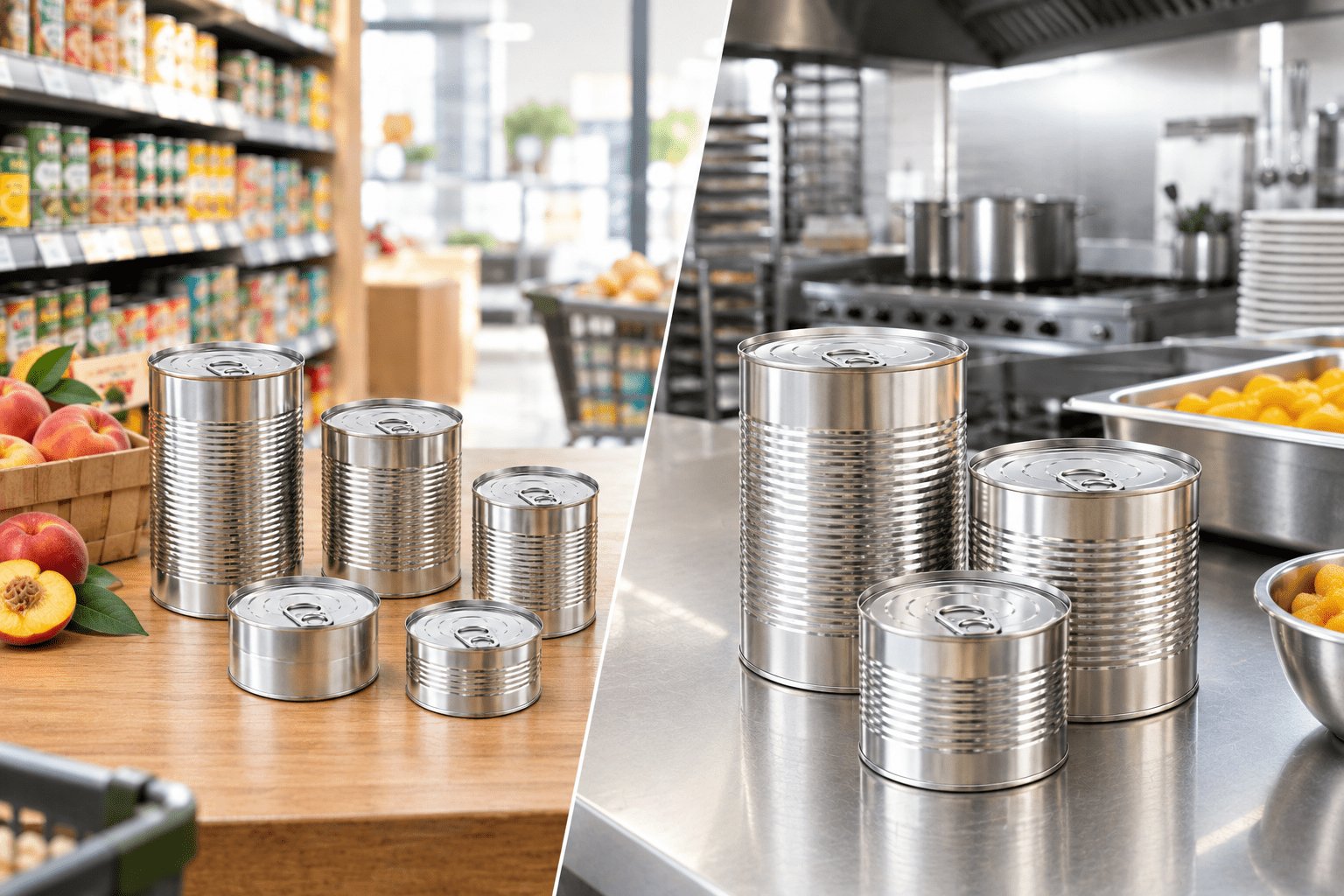

Canned fruit can size selection for retail and foodservice

Retail vs. Foodservice: Why Can Size Requirements Are Different

Retail and foodservice customers may buy the same canned fruit, but their packaging requirements are often very different.

FactorRetailFoodservice
Main userConsumersRestaurants, hotels, bakeries, caterers
Typical usageHousehold consumptionLarge-volume preparation
Main priorityConvenience and shelf appealYield and operational efficiency
Portion controlImportantApplication-dependent
Open-can consumptionUsually smaller quantitiesUsually larger quantities
Waste concernsConsumer leftoversProduct waste and labor cost
Packaging focusConsumer-friendly formatEfficient commercial format

For retail, the question is often: “Will the consumer use most of the can?”

For foodservice, the question becomes: “How many servings can we get from this can, and how much usable fruit will remain?”

There is therefore no universally “best” can size. The right choice depends on the product application and purchasing model.

Don’t Choose a Can Size by Net Weight Alone

One of the most common mistakes when comparing canned fruit specifications is looking only at net weight.

A can’s net weight includes the fruit and packing medium. Depending on the product, this may include syrup, juice, or water.

For many commercial applications, the more useful figure is drained weight—the amount of fruit remaining after the packing medium is removed.

For example, two canned fruit products may have similar net weights but different drained weights. That difference can affect the actual amount of fruit available for a recipe, dessert, bakery filling, or prepared food.

When comparing suppliers, buyers should therefore review:

  • Net weight

  • Drained weight

  • Packing medium

  • Fruit cut and size

  • Fruit-to-liquid ratio

  • Intended application

This is especially important when calculating the real cost of using canned fruit.

How to Choose Can Size for Retail

Retail buyers need to consider the consumer’s purchasing and consumption habits rather than simply selecting the largest available format.

1. Consider Household Consumption

A smaller can may be more suitable when the product is intended for:

  • Individual or small household consumption

  • Ready-to-eat desserts

  • Small portions

  • Occasional use

  • Products where consumers may not use the entire can at once

The goal is to make the package convenient enough that consumers can use most of the product without creating unnecessary leftovers.

2. Match Can Size to the Intended Usage

Not all retail canned fruit is consumed in the same way. A product positioned as a convenient household food may require a different format from canned fruit intended primarily for baking, home cooking, desserts, breakfast applications, or fruit salads.

For baking and cooking products, a somewhat larger retail format may make sense because consumers may use a substantial quantity of fruit in a single recipe.

3. Consider Retail Price Positioning

Can size also affects the final shelf price. A larger package may provide more product, but it also creates a higher ticket price. For private label buyers, this creates a balance between:

Product quantity → Retail price → Consumer perception → Target market

A smaller format can support a lower entry price, while a larger format may provide better value for family-oriented products. Therefore, the right can size should be considered together with the target retail price rather than selected independently.

How to Choose Can Size for Foodservice

For foodservice buyers, the calculation changes. Instead of asking only “How much does one can cost?”, buyers should ask: “How many usable servings does one can provide?”

This is where drained weight and serving size become particularly important.

Start With Servings per Can

A simple calculation can help estimate the required format:

Servings per Can = Drained Weight ÷ Fruit Used per Serving

For example, if a can provides 820 g of drained fruit and a foodservice application uses approximately 80 g per serving:

820 g ÷ 80 g ≈ 10 servings

This does not mean every application will produce exactly 10 servings. Actual yield depends on the recipe, fruit cut, preparation method, and portion size. However, the calculation gives buyers a practical starting point for comparing different can formats.

Match Can Size to Daily Usage

The next question is how much fruit the operation uses each day.

A small café may have relatively low daily demand. Opening a very large can may create unnecessary leftovers. A hotel buffet, catering company, or high-volume restaurant may use much more fruit each day. In that situation, a larger format can reduce the number of cans that need to be opened and handled.

The ideal format therefore depends on: Daily usage + servings per can + consumption speed after opening

The objective is not simply to maximize the amount of fruit in each can. It is to find a format that fits the operation.

The Hidden Cost of Choosing the Wrong Can Size

A can that appears cheaper on a per-kilogram basis may not always be the most economical choice.

Consider a foodservice operation that uses only part of a large can before the remaining fruit becomes difficult to use efficiently. The buyer may save on packaging cost per kilogram but lose money through:

  • Unused product

  • Food waste

  • Additional storage

  • Handling time

  • More complicated kitchen operations

This is why buyers should consider cost per usable serving, not only cost per can.

Can Size Should Also Match the Product Format

Can size is only one part of the packaging decision. The fruit cut should also match the intended application.

For example, canned peaches may be supplied as halves, slices, chunks, or dices. Different cuts offer different functional advantages.If you're comparing specific peach formats, which canned peach cut is right for your application depends on the required appearance, portioning, and end use.

Peach Halves

Work well in applications where appearance and presentation are important, such as desserts, fruit plates, bakery decoration, and retail consumption.

Peach Slices

Convenient for applications where fruit needs to be portioned or distributed, including bakery, desserts, breakfast applications, and foodservice preparation.

Peach Dices & Chunks

Suitable for fruit mixes, yogurt, bakery fillings, desserts, and food manufacturing.

Therefore, buyers should not specify only the can size. A more complete product specification may include:

Fruit + Cut + Packing Medium + Net Weight + Drained Weight + Packaging Format

This gives suppliers a much clearer understanding of the actual application requirements.

Don’t Ignore the Packing Medium

The packing medium is another factor that should be considered when selecting canned fruit. Common options include syrup, juice, or water.

The choice can influence the product’s sweetness, flavor profile, application, and consumer positioning.

For example, a retail product designed for dessert consumption may have different requirements from an ingredient used in a bakery or food manufacturing application.

This is why buyers should evaluate the can size and packing medium together rather than treating them as completely separate decisions. The same can size can deliver a different commercial value depending on the packing medium and drained fruit specification.

Retail vs. Foodservice: A Practical Selection Guide

For Retail Buyers

Consider:

  • Who is the target consumer?

  • How many servings should one can provide?

  • Is the product designed for single-use or family consumption?

  • What retail price are you targeting?

  • Will consumers use the fruit for eating, baking, or cooking?

  • How important is convenient storage after opening?

  • What package size fits your private label positioning?

For Foodservice Buyers

Consider:

  • How much fruit is used per serving?

  • How many servings are required each day?

  • How quickly will an opened can be consumed?

  • What level of leftover product is acceptable?

  • What is the target cost per serving?

  • Does the kitchen prioritize convenience or maximum yield?

  • Would a larger format reduce handling and opening frequency?

Answering these questions can help buyers avoid choosing a can size based solely on unit price.

A Simple Formula for Choosing the Right Can Size

Before requesting quotations from suppliers, buyers can work through the following steps.

  1. Step 1: Calculate Fruit Usage
                               Estimate how much fruit the application uses per day or per production batch.

  2. Step 2: Determine Serving Size
                               Establish how many grams of fruit are required for each serving or finished product.

  3. Step 3: Calculate Expected Yield
                               Use drained weight to estimate the number of servings a can can provide.
                               Expected Servings = Drained Weight ÷ Fruit per Serving

  4. Step 4: Estimate Leftover Product
                               Consider whether the entire can can realistically be used within the intended period after opening.

  5. Step 5: Compare Cost per Usable Serving
                               Compare different can formats based on usable fruit rather than simply price per can.

  6. Step 6: Check the Complete Specification
                               Confirm can size, net weight, drained weight, fruit cut, packing medium, packaging type, and product application.

This approach makes it easier to compare supplier quotations on a like-for-like basis.

Can Size Selection Checklist for Buyers

For Retail

  • Does the can size fit the target household?

  • Does it support the desired retail price?

  • Is the portion convenient for consumers?

  • Will the product be used primarily for eating, baking, or cooking?

  • Is the format suitable for private label positioning?

For Foodservice

  • How many servings does one can provide?

  • What is the actual drained fruit yield?

  • How quickly will the can be used after opening?

  • How much waste could be generated?

  • What is the real cost per serving?

  • Does the can size improve kitchen efficiency?

The right answers will usually point toward the appropriate packaging format.

Final Takeaway: Choose the Can Around the Application

The right can size is not necessarily the smallest, largest, or cheapest option.

For retail, the decision should balance consumer convenience, portion size, shelf price, and household usage.

For foodservice, the focus should shift toward drained yield, servings per can, waste control, labor efficiency, and cost per usable serving.

Most importantly, can size should be evaluated together with fruit cut, packing medium, net weight, and drained weight.

When sourcing canned fruit, the best starting point is not simply “What can sizes do you offer?” A better question is:

Working with a supplier that can adjust fruit cuts, packing media, weights, and packaging specifications can make it easier to develop the right format for your market.

At Countree Food, we work with buyers on canned fruit specifications for different retail, foodservice, and food manufacturing applications. Whether you need canned peaches, pears, mandarins, sweet corn, or other canned fruit products, the right combination of format, cut, packing medium, and weight can be developed around your market requirements.

Need the Right Can Size for Your Market?

Whether you’re sourcing for retail, foodservice, or industrial applications, Countree Food offers a wide range of canned fruits and vegetables with flexible specifications and packaging options.

Explore Our Canned Fruit & Vegetable Products
Follow us:
Unlock Exclusive Insights & Offers:
Subscribe below for the latest updates and inquiries

0086-15066222743

SEND INQUIRY
INQUIRY